
In the previous article “Strategy Execution: From Plan to Impact”, I showed that strategy needs different levels of steering. We distinguish between Small, Medium, and Large.
Large means a fixed structure. It connects goals, KPIs, projects, and decisions. As a result, execution stays on track.
But what happens when even that is not enough?
Then temporary operational leadership may be needed. An experienced interim manager can step in fast. They take responsibility and make decisions. In addition, they remove roadblocks. This helps stabilize the organization.
So an important question arises: How can temporary leadership create lasting impact?
Success is not only about what happens during the mandate. Just as important, it is about what remains after the interim manager leaves.
Interim Management in Restructuring Creates Speed
The AIMP DACH Market Study 2026 shows the importance of interim management. Typical fields include transformation, restructuring, and critical leadership situations. Moreover, current research supports this role. Temporary leaders can be especially useful in times of crisis.
Laura Jane Packheiser and Svenja Marie Pröpper identify three roles in their study “Turning the Tide: Typology of Temporary Managers in Decision-Making During Crises”: Realiser, Decider, and Advisor.
This matters because not every crisis needs the same support. For example, one company may need advice. Another may need clear decisions. By contrast, a third may need hands-on leadership.
Therefore, the key question is not only: Consultant or interim manager?
Instead, the better question is: What type of responsibility does the situation require?
Today, labels matter less. What matters more is whether analysis, decisions, and execution work together.
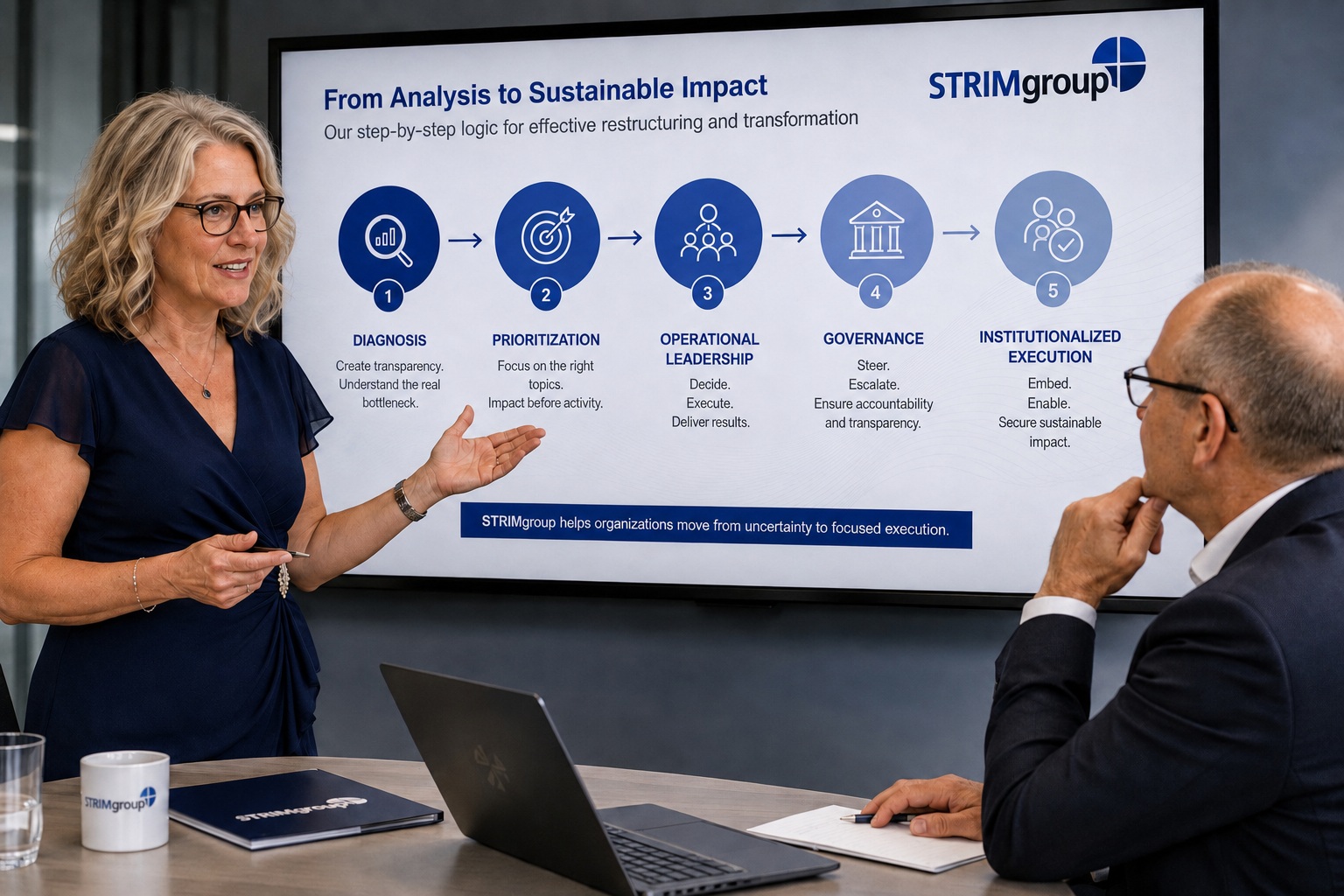
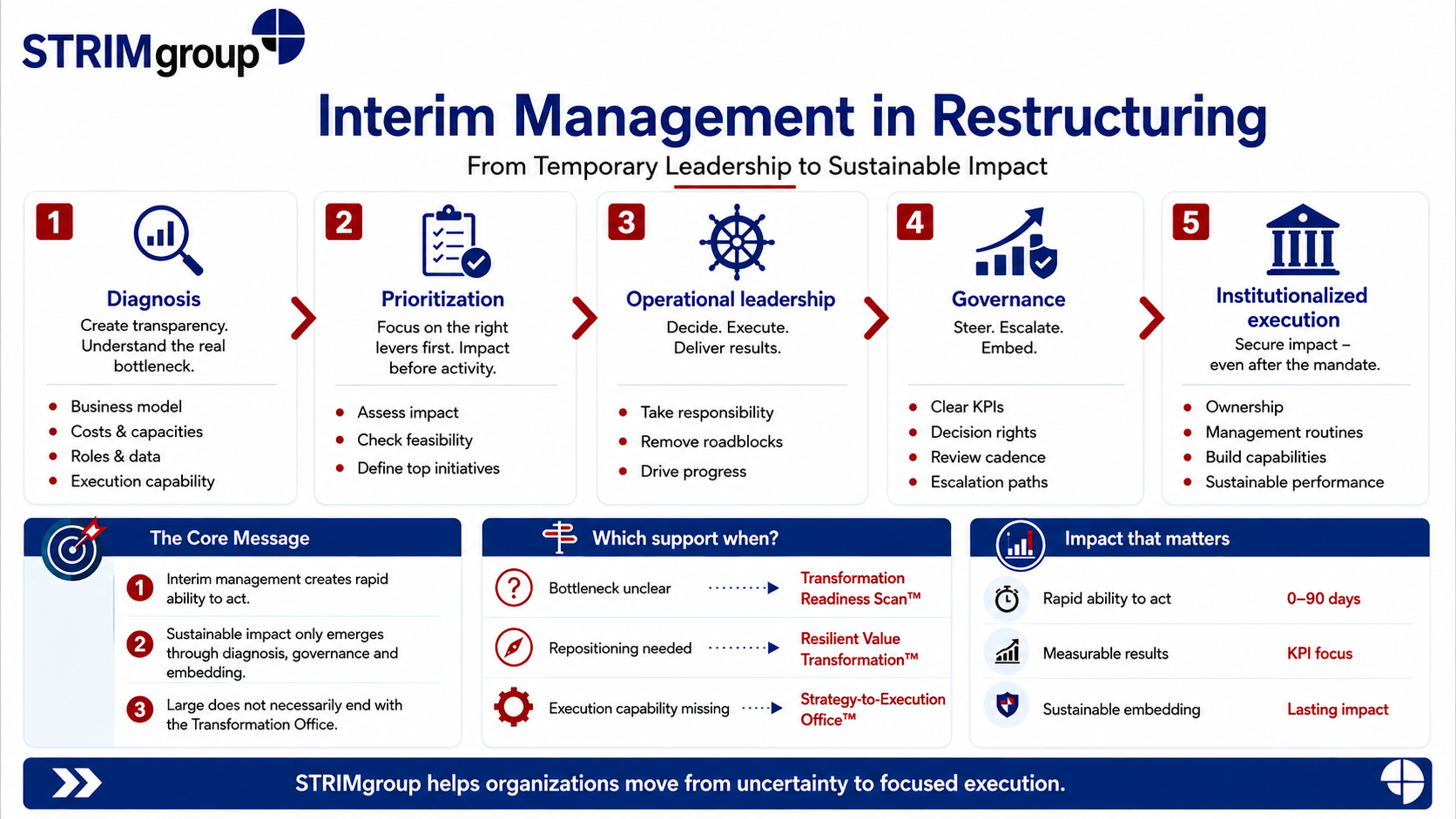
1. Diagnosis: Understand the Real Bottleneck First
In restructuring, time matters. Still, a company should not launch too many actions at once.
A study by Chanchai Tangpong, Derek Lehmberg, and Zonghui Li highlights the problem. New leaders often need to decide fast. At the same time, they may not yet know the company well enough. The same applies to interim managers.
Therefore, the first step is to clarify the real problem:
- Is the business model under pressure?
- Are costs or capacities too high?
- Are roles and tasks unclear?
- Are key capabilities missing?
- Are data and KPIs unreliable?
- Or is execution the main weakness?
The answer shapes the next step.
This is exactly where the STRIM Transformation Readiness Scan™ comes in. It quickly shows where the main bottleneck lies.
The idea is simple: Do not start by doing as much as possible. Start by solving the right problem.
Diagnosis also answers a second question. It shows what kind of responsibility is needed.
Is analysis enough? Does the company need stronger steering? Or does it need hands-on leadership?
This also explains why consulting and interim management are moving closer together. Consulting brings analysis and structure. Interim management adds leadership and execution. Together, both can create more impact.
2. Prioritization: Do Not Do Everything at Once
After diagnosis comes selection.
In a crisis, there are often too many issues. Costs must fall. Processes need to improve. Structures must change. At the same time, many projects may already be running. This can quickly lead to action without focus.
Therefore, they need a clear order of action. Which measures create the most value? What can be done quickly? Which steps must come first?
Prioritization means: Fewer topics. Clear responsibility. More impact.
Depending on the situation, a STRIM Resilient Value Transformation™ may be the next step. This is especially useful when deeper structural problems exist.
However, if execution is the main bottleneck, another type of support is needed.
3. Operational Leadership: Take Responsibility
This is where interim management shows its strength. At some point, showing options is no longer enough. Someone must decide. Someone must push measures forward. Ultimately, someone must deliver results.
This creates an important line: the line between recommendation and responsibility.
Put more simply: Who says what should be done? And who makes sure it happens?
An interim manager is therefore measured by impact. The task is to solve problems and stabilize the company. In addition, the interim manager must drive execution.
In our previous article, we described the Large version of the STRIM Strategy-to-Execution Office™. Large creates a clear rhythm. It improves transparency. Moreover, it prepares decisions and follows up on them.
In restructuring, however, the role may go further. Then management may need someone who takes direct operational responsibility. This is exactly where Strategy-to-Execution and interim management meet.
4. Governance: Turn Leadership into a System
Operational leadership alone is not enough. A restructuring effort should not depend on one person. Therefore, it needs governance.
This includes, for example:
- a few clear KPIs,
- fixed review meetings,
- clear decision rights,
- short escalation paths,
- clear responsibilities.
The principle is simple: Information is not the same as steering.
A report only adds value when it leads to action.
BCG describes a similar development. AI can make reporting and status updates easier. However, the key decisions still belong to management. Leaders must decide. They must step in when needed. In addition, they must make responsibilities clear.
In this way, personal leadership becomes a system. This matters even more when an interim manager only stays for a limited time.
5. Institutionalized Execution: What Remains After the Mandate?
This is where lasting impact is decided. A strong interim manager can achieve a lot in a short time. Afterwards, however, the company must be able to steer on its own.
Therefore, key capabilities need to remain inside the organization:
- clear roles,
- a small number of relevant KPIs,
- fixed review cycles,
- clear escalation paths,
- documented routines,
- internal capabilities,
- clear ownership.
Middle management plays a key role here. This is where a new approach becomes daily practice. It is also where decisions are turned into action. Finally, this is where the company sees whether new routines really last.
Therefore, handover should not start at the end of the mandate. Instead, it should begin from day one.
The Step-by-Step Logic for Lasting Impact
Not every company needs every step to the same degree. When crisis pressure is high, an interim manager may be needed at once. In other cases, a short diagnosis is the better first step. This helps avoid spending time and money on the wrong issue.
Therefore, the main question is not: Consulting or interim management?
A better question is: What mix of analysis, steering, and operational responsibility does our situation need?
This is the difference between a single mandate and an integrated transformation approach.
Conclusion: Impact Must Remain After the Mandate
The previous article “Strategy Execution: From Plan to Impact” asked: How much steering does strategy execution need?
Restructuring adds a second question: When should steering turn into operational responsibility?
Interim management can create fast action. That is why it is especially valuable in critical situations.
However, lasting impact comes later. The organization needs clear roles. It needs useful KPIs. In addition, it needs clear decision paths. Most importantly, it must be able to keep steering on its own.
Therefore the key question is not only: What can the interim manager achieve in 90 days?
There is also a second question: What can the company do better on day 91 than it could before?
That is exactly what the STRIM approach aims to achieve.
STRIMgroup helps organizations move from uncertainty to focused execution.

Leave A Comment