
Companies in transition are facing several structural shifts at the same time. Trade and investment flows are changing, Europe is building new industrial capacity, and energy security and security of supply are becoming increasingly strategic issues. Artificial intelligence is moving beyond the software domain into manufacturing, logistics and infrastructure. At the same time, cost pressures, margin pressure and the need for restructuring remain high.
For companies in transition, the key management question is therefore not how quickly they can respond to every new development with yet another initiative. What matters is which changes are genuinely relevant to the business model, which lever should take priority, and how these priorities can be translated into measurable execution.
Capital and value creation are being redistributed
A particularly visible sign comes from the trend in German foreign investments. In the first half of 2026, German companies increased their direct investments in China by about one-third, according to an analysis by the German Economic Institute. At the same time, investments in the U.S. declined significantly.
However, this should not be hastily interpreted as a return to old patterns of globalization. Rather, a new selectivity is emerging: Companies must take a more holistic view of sales markets, geopolitical risk, energy prices, supply chains, access to technology, and available expertise.
At the same time, new capital flows are emerging toward Europe. The United Arab Emirates announced additional investments of 40 billion euros in Germany. The collaboration encompasses, among other things, energy, digital infrastructure, and industrial projects. RWE and Masdar also plan to collaborate on offshore wind projects; the potential investment volume amounts to more than three billion euros.
This is also changing the logic behind location decisions: they are increasingly becoming an integrated consideration of capital, technology, energy, and workforce.
What Reindustrialization Means for Companies in Transition
However, these investments should not be equated with a widespread industrial upswing. In the first half of 2026, German local courts recorded 12,812 corporate insolvencies; that was 6.7 percent more than in the same period the previous year and the highest half-year figure in 13 years.
It is precisely this simultaneity that defines the new economic reality: growth and restructuring, investment and cost pressure, expansion and downsizing no longer occur in a neat sequence.
At the same time, significant new capacity is emerging in individual sectors. In September 2026, ASML began construction of a second large industrial campus in the Brainport region. In the long term, the site could accommodate up to 20,000 jobs.
Rheinmetall, for its part, is investing around 270 million euros in Kassel. Plans include, among other things, additional production capacity, a new logistics center, and activities related to drone technology.
For companies in transition, this creates a challenging dual task: ensuring short-term performance while simultaneously laying the groundwork for future growth.
AI Is Evolving from an IT Topic into a Business Model Issue
A third shift is at least as far-reaching: AI is becoming physical.
In September 2026, Einride and Lidl deployed a driverless Level 4 truck on public roads in Germany for the first time. The operation was approved by the Federal Motor Transport Authority.
This fundamentally changes the management question.
It is no longer just a matter of where generative AI can support employees in the office. As AI enters production, logistics, engineering, or maintenance, work processes, roles, skill requirements, decision-making authority, and governance all change.
This development is also becoming apparent on the infrastructure side. The European chip supplier Axelera AI now reports more than 600 customers and has signed supply contracts for European AI factories.
The new generation of chips is to be scaled using systems from Dell and Supermicro, among others.
AI adoption is therefore increasingly becoming a business model issue.
For tech and semiconductor companies, compute capacity, energy, chips, and data infrastructure are taking center stage. In mechanical engineering and the automotive sector, the focus is more on productivity, automation, and changing role profiles. The defense and aerospace sectors face the challenge of rapidly scaling production capacity while securing scarce specialist expertise. European defense companies and new providers are currently significantly expanding their manufacturing capacity.
Energy and infrastructure companies, in turn, must balance long-term investments with security of supply and regulatory requirements.
Different industries, but the same overarching challenge: strategy, technology, workforce, and execution must be more closely integrated.
Volkswagen in Osnabrück provides a particularly illustrative example. There, traditional automotive production is set to phase out by 2027, and the site will be gradually transformed into a center of excellence for security and defense solutions. Such shifts affect not only products and markets but also roles, skills, and workforce structures directly.
Companies in Transition: What Are the Priorities Now?
Many companies are responding to this complex situation with additional projects. This is precisely where the risk lies.
The recurring patterns are now clearly recognizable: technology investments become workforce issues, location decisions turn into scenario planning, and growth becomes an execution issue.
This, in turn, raises various but closely interrelated questions for management.
The CEO must decide which of the numerous courses of action genuinely deserve strategic priority. The CFO needs robust scenarios before committing capital for the long term. And the CHRO must increasingly plan ahead to determine which capacities, roles, and competencies will be needed in the future—not only after bottlenecks have already arisen.
The crucial question is therefore not: Which ten additional initiatives could we launch?
Rather: Which changes are truly relevant to us? Where is the dominant lever? And which decisions must we make now?
How Companies in Transition Can Turn Change into Execution
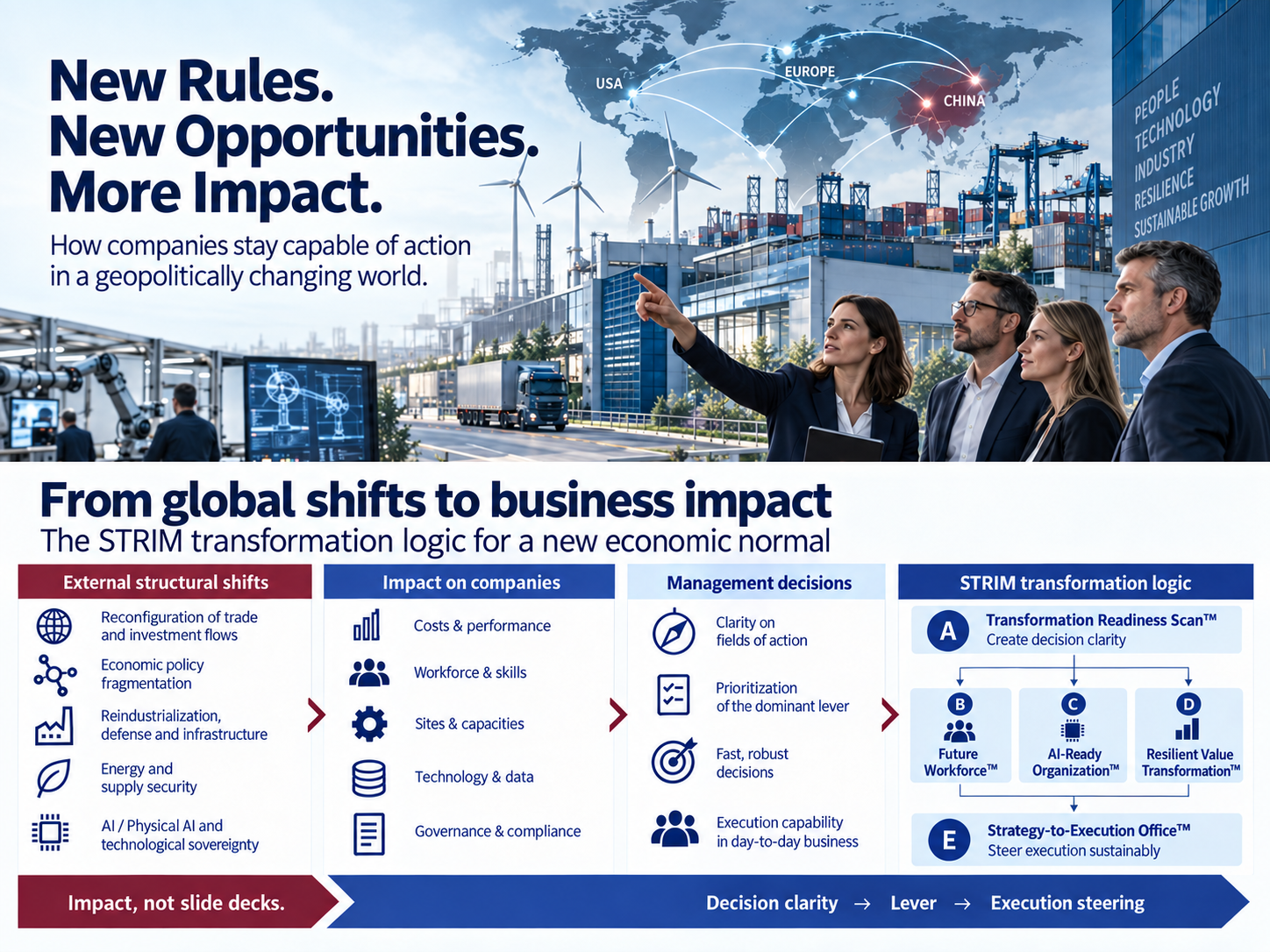
This is precisely where STRIMgroup’s transformation logic comes into play.
The starting point is not a pre-packaged transformation program. The first step is clarity.
The Transformation Readiness Scan™ creates a robust basis for decision-making and identifies the key lever for action. Only then—depending on the initial situation—does the focus shift to Future Workforce™, AI-Ready Organization™, or Resilient Value Transformation™.
The Strategy-to-Execution Office™ ensures sustainable execution: priorities, KPIs, responsibilities, and decision-making routines are embedded in day-to-day management. STRIMgroup also describes the underlying logic in recent articles on strategy implementation and AI readiness.
The logic behind it is deliberately simple: decision clarity → levers → execution steering.
Or to put it another way: first clarity, then focused intervention, then institutionalized impact.
This is deliberately not a catalog of individual consulting services. It is a response to a structural management problem: In the current situation, companies rarely suffer from a lack of possible courses of action. What is more difficult is prioritizing the right options and implementing them consistently amid high uncertainty.
How robust is your transformation logic?
The coming months will bring new geopolitical, technological, and economic signals. Not all of them will be relevant to every company.
For companies in transition, the ability to quickly assess new signals, set priorities, and execute decisions consistently is therefore becoming increasingly important.
When external changes occur faster than internal decision-making processes, the next major initiative is not automatically the answer.
First, three questions should be answered:
Where does our company face the greatest pressure to act? Which lever produces the greatest impact? What decisions must we make in the next 90 days?
The STRIM Transformation Readiness Scan™ quickly creates a robust basis for decision-making and links it to concrete next steps.
Impact, not slides.
