Strategy rarely loses impact in the boardroom. It loses impact on the way into daily business.
A lot happens between a decision and a result. Priorities change. Decisions are delayed. KPIs show activity but not impact. At the same time, daily operations push strategic topics aside.
In our article on the Execution Gap, we explored this gap. This leads to a second question:
How much steering does strategy execution need to close this gap for good?
TThere is no standard answer. A clearly defined strategic topic needs a different rhythm from a transformation that spans many business areas.
That is why the STRIM Strategy-to-Execution Office™, or S2E Office, comes in three levels: Small, Medium and Large. These are not three different methods. Instead, they are three levels of the same operating logic.
Strategy execution needs a clear management rhythm
A good roadmap is matters. However, it is not enough. Strategy becomes steerable only when goals, KPIs and decisions come together on a regular basis. Clear accountability is also essential. In addition, leaders must know when to step in and when to change priorities.
This is where the Strategy-to-Execution Office comes in. It creates a closed management loop between strategy and daily work.
During the first 30 days, the steering foundation is built. After that, the regular run rhythm begins. Impact is measured continuously. At the same time, the system improves from cycle to cycle.
For the CEO, the question is simple: Are strategic decisions actually being implemented?
The CFO asks a different question: Which investments create impact, and where should resources be shifted?
For the CHRO, the issue is whether the organisation has enough capacity to deliver the planned change.
These questions are different. Yet they lead to the same point: Strategy execution needs more than reporting.
PwC and BCG: Transformation Offices are changing too
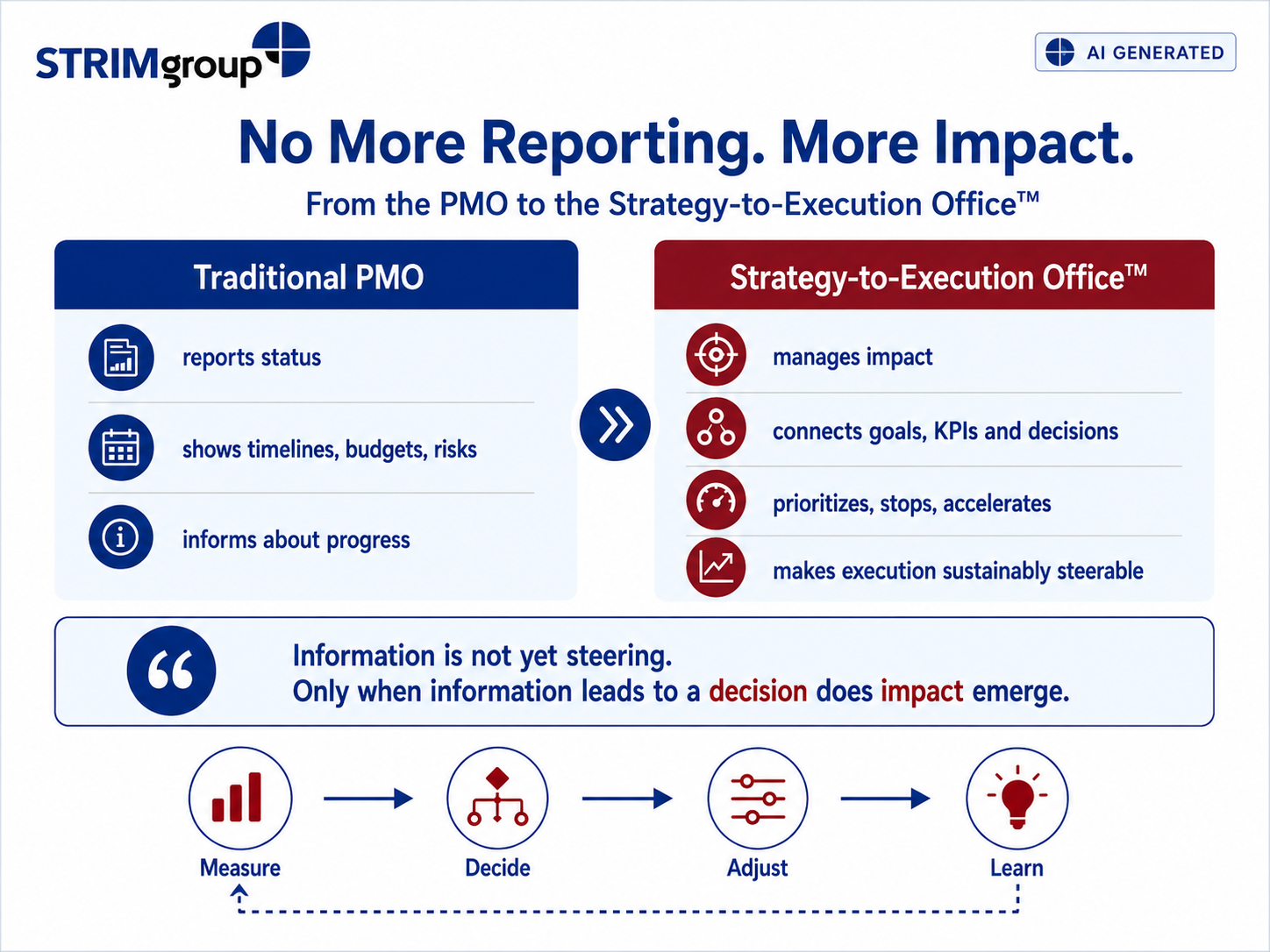
Large consulting firms are moving in the same direction. PwC describes the evolution of the PMO as a shift “from oversight to outcomes”. Many Transformation Management Offices still operate too much like traditional PMOs. They collect information and report status. However, effective execution needs clear decisions, clear accountability and a strong focus on results. So the focus is changing: away from reporting and towards impact.
BCG makes a similar point. In July 2026, the firm described a more AI-enabled Transformation Office. Routine work such as status checks, updates and early risk detection can increasingly be automated. As a result, leaders can spend more time on what really matters: prioritising, deciding and intervening. At the same time, governance, decision rights and accountability remain human responsibilities.
This makes the key difference clear: Information is not yet steering. Impact starts when information leads to a decision.
Three real-world cases show how different this management rhythm can be.
Small: Steering one strategic field with focus
Project Profile. An automation and sensor technology company received support for its sales steering over a period of around two years. The scope was clear: strategy, planning, budgeting and sales controlling.
Initial Situation. Customer potential had been identified and sales activities were underway. Still, one key question remained unanswered: Did the relevant potential actually turn into opportunities and, later, into orders?
Task. Management did not need another sales strategy. Instead, it needed to see where potential turned into business and where it did not.
Solution. A regional sales controlling system linked existing potential with opportunities and orders. In addition, trends were tracked over rolling periods.
Results and Value. Management gained a consistent view of how potential developed. Regional differences also became more visible. As a result, reviews could focus more closely on actual business outcomes.
This is typical Small. The scope is clearly defined. Internal delivery capacity is already in place. Therefore, the main needs are strong KPIs, regular reviews and clear decisions.
Medium: Steering several impact areas together
Project Profile. An energy company received support for its HR strategy over five years. The work included a relaunch of the HR strategy, competency models, KPI definitions, an HR KPI system, monthly reporting and regular reviews of the strategic HR roadmap.
Initial Situation. The strategy was not meant to stay on paper. It had to be translated into leadership, skills and concrete goals. Managers therefore needed to understand the strategic goals and apply them in their own areas. One KPI was no longer enough. Leadership, recruiting, retention, succession, skills and efficiency all had to be viewed together.
Task. At the core was one question: Is the organisation moving in the direction defined by the strategy?
Solution. Several steering areas were connected. They included efficiency, leadership, turnover risk, employee satisfaction, succession and recruiting. Leadership development was also measured beyond participation. Learning, application at work and business value were included as well. As a result, the focus shifted from activity to impact.
Results and Value. Over time, a fixed rhythm developed between strategy, leadership, KPIs and roadmap reviews. Progress could be assessed regularly, and actions could be adjusted.
That is what defines Medium. Several impact areas run in parallel. Therefore, they need to be aligned and actively steered on a regular basis.
Large: Embedding strategy execution across the organisation
Project Profile. At a mid-sized insurance company, a Strategy Office was newly established and put into operation. It reported directly to the CEO. The goal was to build a company-wide structure for strategy execution. After an initial pilot, further areas were added step by step. A wave approach allowed lessons from one round to flow into the next.
Initial Situation. Strategy development and execution needed a lasting link. At first, some areas lacked clear leading and outcome indicators. Strategic and operational actions were also not always separated clearly. Therefore, responsibilities and commitments had to become more binding.
Task. The central question was: How can a newly created Strategy Office steer execution across the company without taking responsibility away from the Executive Board and business leaders?
Solution. The Strategy Office was set up as a central steering unit with a direct reporting line to the CEO. After the proof of concept, the approach was introduced in further areas. Focused goals, leading indicators, scoreboards and fixed steering routines were used. In addition, impact and execution progress were reviewed together at portfolio level. This made it easier to see where execution was progressing and where management action was needed.
Results and Value. At the documented stage, the relevant areas had been integrated and the steering mechanisms were in use. Some areas also reported stronger ownership of execution and a greater focus on processes from the customer’s point of view. However, the most important lesson was structural: A Strategy Office can create the framework for execution. Accountability for priorities and decisions remains with top management. That is what defines Large.
Strategy execution with Small, Medium, or Large
All three examples follow the same basic idea. However, the level of steering differs.
Small fits a manageable portfolio. Internal execution already works well. Therefore, KPIs, reviews and decisions are the main focus.
With Medium, several topics run in parallel. As a result, the need for alignment increases. Priorities, blockers and results must be brought together more closely.
Large, by contrast, is designed for high complexity. Several business areas are involved. Therefore, the S2E Office creates a stable structure across organisational boundaries.
The key point is simple: Company size does not determine whether Small, Medium or Large is right. Portfolio, complexity and steering needs do.
No more reporting. More impact.
The operating logic follows a cycle: Goals → KPIs → Portfolio → Executive Steering → Impact → Learning → Adjustment
The process does not end with a review. First, outcome KPIs show whether results are being achieved. Next, blockers are addressed and priorities are checked. Finally, new insights flow into the next cycle.
This makes strategy execution more precise with every round. At the same time, the system learns from its own results. That is the core of a self-improving management cycle.
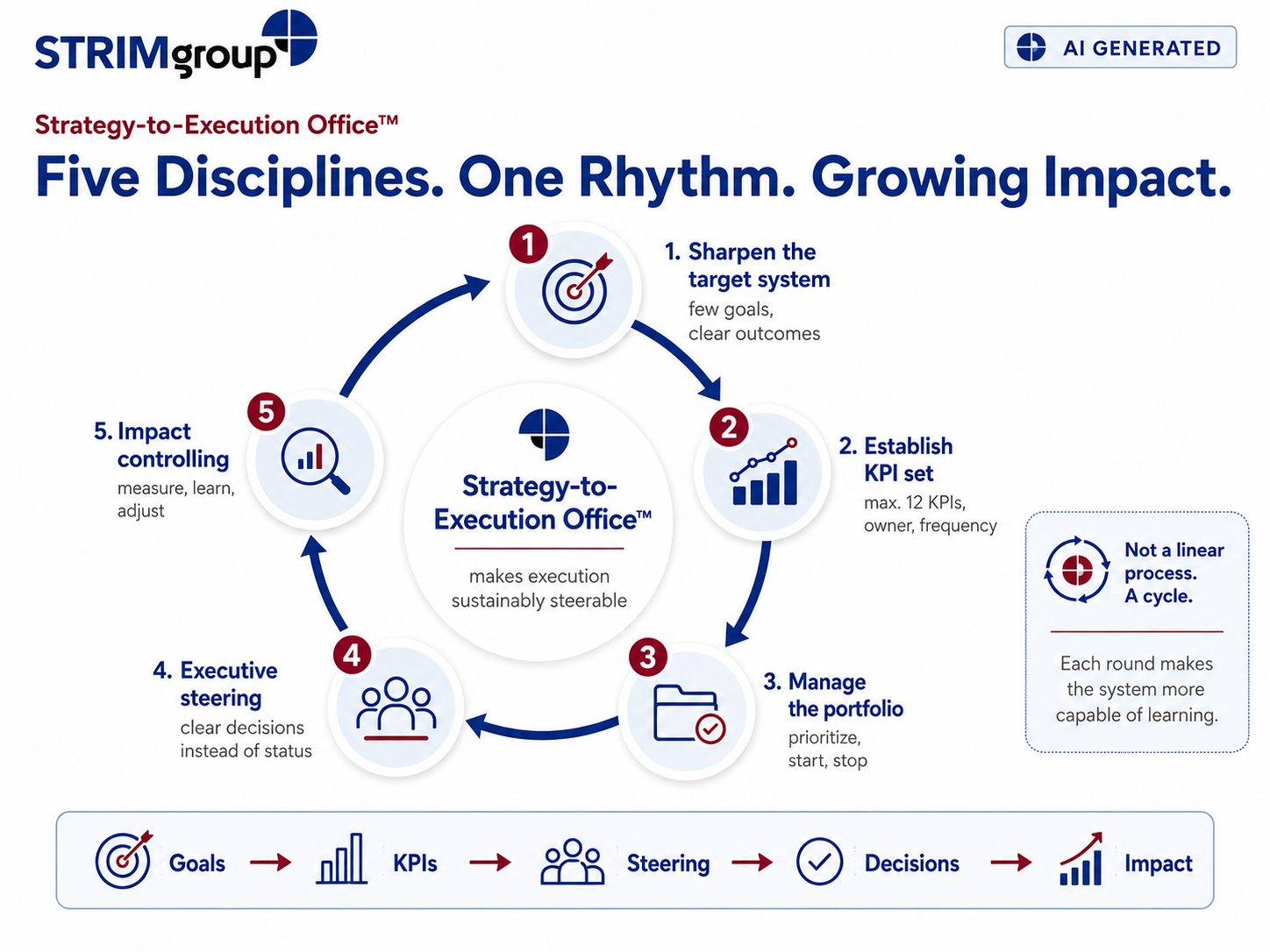
The difference from a traditional PMO then becomes clear: A PMO reports status. A Strategy-to-Execution Office steers impact. This is more than a different label. It is a different management task.
Conclusion: Complexity determines the level of steering
Not every company needs Large. Still, every strategy needs a reliable rhythm between decision and impact.
For a clearly defined topic, Small may be enough. When several impact areas run in parallel, Medium is often the better fit. A company-wide transformation, however, needs a stable structure across several areas — Large.
Three questions provide a quick first check:
- Who keeps our execution rhythm running?
- Which KPIs actually lead to decisions?
- When did we last change or stop an initiative because of its measured impact?
If the answers are unclear, the problem may not be the strategy. It may be the way the strategy is steered.
Strategy does not create impact through more slides. It creates impact through clear decisions, effective KPIs and a stable management rhythm.
If you would like to understand which level of steering — Small, Medium or Large — fits your situation, talk to us.

Leave A Comment