

AI Readiness: Why AI Agents only deliver results when backed by reliable data
Data quality, data analysis, and governance are becoming critical success factors for effective AI transformation.
In early May 2026, Anthropic introduced new agent templates for financial services. These support tasks such as pitch books, KYC checks, and monthly closing processes. The rationale is clear: AI is no longer intended merely to assist. Instead, it is expected to make specific workflows in finance, risk, and compliance more productive. As a result, the market for AI-powered business processes is changing rapidly.
However, this also highlights a key management reality: AI agents are only as effective as the data foundation on which they operate. If data is not organized, trustworthy, or auditable, even the best AI application will fall short of its potential. This is not a minor technical issue. Rather, it is a strategic prerequisite for reliable decision-making.
Why AI Agents Need a Reliable Data Foundation
AI agents promise to accelerate complex work steps. They gather information, prepare analyses, and identify deviations. In practice, however, reliable results only emerge when the underlying data is visible, understandable, and verifiable.
Without this foundation, typical risks arise. These include inconsistent data versions, manual shadow processes, and unclear decision logic. In short, AI may be implemented, but it is not truly made controllable.
This is particularly critical in finance and HR transformations. In these areas, the focus is not only on efficiency. It is also on reliability, compliance, and impact. That is why AI readiness means more than selecting a tool. It means enabling the organization to use data analytics in a way that is repeatable, explainable, and relevant to decision-making.
Data Quality is More Than an IT Issue
Many companies still treat data quality as a technical problem. In reality, however, it is a leadership and transformation task. This is because data quality does not arise from systems alone. It also depends on clear goals, roles, and responsibilities.
Crucial questions include:
- Which data is truly relevant for which decision?
- Who is responsible for data quality?
- Which use cases generate measurable benefits?
- What governance is necessary to ensure that results remain traceable and auditable?
Only when these questions have been answered can data analytics achieve its full potential. This is precisely where STRIMgroup comes in: at the intersection of strategy, organization, and implementation.
Where Alteryx Provides Technological Support
Alteryx addresses a key challenge: preparing and connecting data from various sources more quickly and building repeatable workflows. With Alteryx One, the company positions itself as a platform for data integration, self-service analytics, and AI-ready data preparation.
This is particularly relevant because many business units still rely on manual Excel processes and fragmented data sources. Technology can make a significant contribution here. It can reduce repetitive processes, standardize workflows, and empower business units to arrive at reliable results more quickly.
Nevertheless, technology alone does not create AI readiness. It requires a clear business framework, prioritized use cases, and an organization that translates results into decisions.
The Contribution of STRIMgroup
STRIMgroup combines strategic consulting, analytics expertise, and implementation experience. The focus is not on the isolated introduction of individual tools. Instead, the key question is: How do companies move from AI readiness to measurable impact?
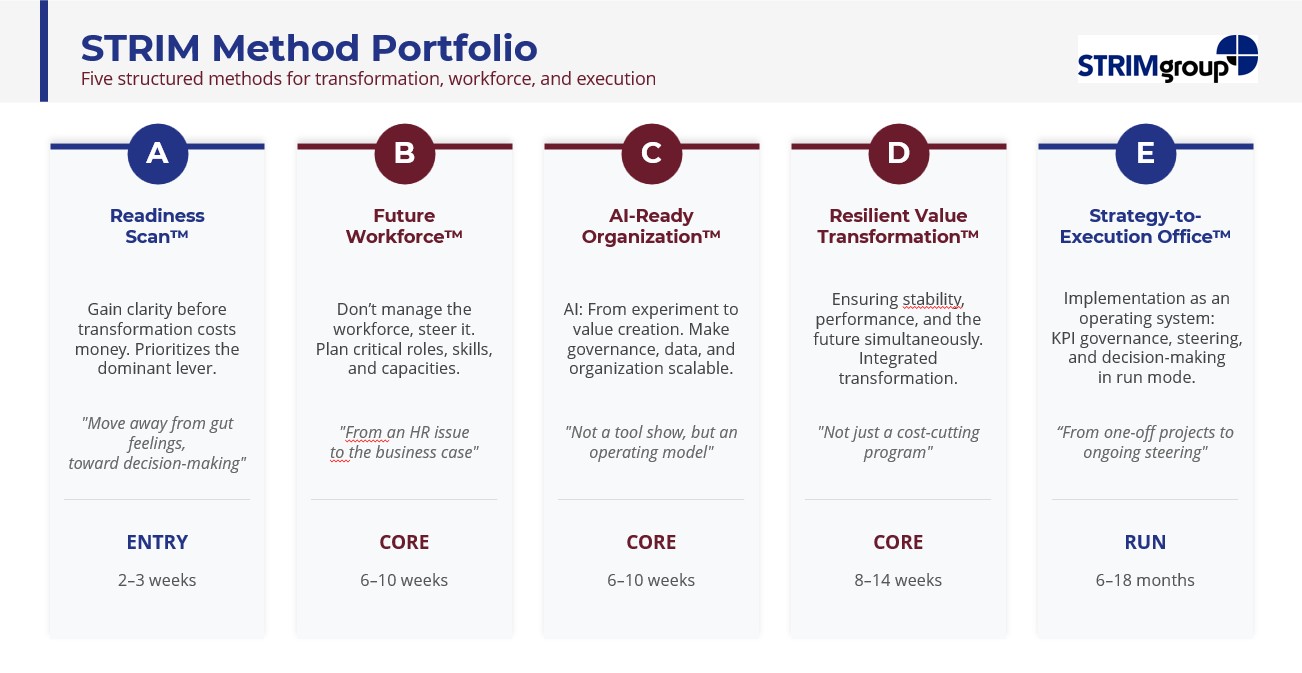
With STRIM AI-Ready Organization™, STRIMgroup establishes the organizational and data-related prerequisites for the use of AI and analytics. This includes the target vision, governance, roles, use case prioritization, and an implementation roadmap.
The STRIM Transformation Readiness Scan™ serves as the starting point. It systematically assesses where a company stands today. How robust is the data foundation? How clear are management logic and responsibilities? Which use cases are ready for implementation?
Building on this, the STRIM Strategy-to-Execution Office™ ensures that strong concepts do not get stuck in presentations. Instead, they are translated into prioritized measures, clear responsibilities, and a robust operating model for analytics and AI.
In HR and people analytics contexts, STRIMgroup complements this approach with expertise in predictive HR analytics, strategic workforce planning, and the automation of recurring analytics processes. After all, analytics only becomes a true management lever when data, processes, and management logic work together.
From AI Readiness to Measurable Impact
The current market momentum around AI agents makes one thing clear: the next stage of AI development will not fail because individual applications are unavailable. Rather, it will fail if companies have not sufficiently prepared their data, processes, and organizations.
For decision-makers, this means that companies seeking to use AI agents or automated data analytics should not start with the tool question. The better starting point is an honest assessment of the current situation: Which decisions need to be improved? What data is needed for this? How can a use case become a scalable management process?
STRIMgroup supports companies precisely along this path: from the initial readiness assessment and target vision through to implementation. Together with technology partners such as Alteryx, this creates an approach that views AI readiness not as a buzzword, but as a concrete organizational capability.
Let us work together to assess where your company stands on the path toward data, analytics, and AI readiness — and which use cases can make the greatest contribution.
