

Your biggest execution problem is probably not a project that fails. It is one that nobody ends. Project prioritisation therefore starts with an uncomfortable question: which of our current projects would we not start again today? Growth initiatives, AI pilots and efficiency programmes compete for the same budgets, managers and specialists. Companies that pursue everything at once slow down precisely their most important initiatives.
The first part of this series, Skills shortage in SMEs: The Dangerous Breathing Space, looked at building critical capabilities in good time. That takes months, often years. The second lever works faster: freeing up capacity. And that only succeeds if companies consciously decide what they will stop doing.
Why project prioritisation is now a matter for the top
Pressure to adapt business models is rising. In a Project Management Institute survey from December 2025, 93 per cent of 300 senior executives say they must rethink their business model or ways of working at least every five years. Almost two thirds do so every two years or more often. Strategy execution therefore no longer just means implementing decisions reliably. It also means regularly checking which initiatives still deserve resources under changed conditions.
A new driver adds to this: AI multiplies the number of initiatives. According to McKinsey’s “The State of AI in 2026” (1,719 respondents, August 2026), 80 per cent say AI improves their productivity. Yet only 37 per cent see any contribution to operating profit, practically unchanged from the previous year. BCG therefore recommends focusing AI on two or three domains where it moves a business metric. One domain rebuilt properly, BCG argues, delivers more than ten explored superficially. What applies to AI applies to every project portfolio.
The real bottleneck is people, not budgets. In “Five principles for designing brain-powered organizations”, McKinsey describes human thinking and judgement capacity as a growing bottleneck. Leaders should manage cognitive load and enable focus. This is particularly noticeable in mid-sized companies. An experienced manager who supports three strategic projects is missing from day-to-day business and from the fourth project.
Project prioritisation by value: project success is not business success
The PMI study draws on more than 5,800 project professionals. Measured by the value created, only 50 per cent of projects achieve success in which the benefits exceed effort and cost. Another 37 per cent deliver only in part, and 13 per cent fail.
A project can therefore be completed on time and on budget and still create too little value. Traditional project controlling checks time, budget and milestones. Management must also ask whether the expected results are still relevant. Arjun Asokakumar sums it up for AI pilots: many fail because companies confuse activity with value.
Writing in MIT Sloan Management Review, Mika Ruokonen and Paavo Ritala therefore recommend a portfolio approach: initiatives are managed like any other major investment, with a business case, governance and portfolio metrics. Progress reports should accordingly show three things: whether the assumptions hold, whether economic impact is emerging and which decision is needed now.
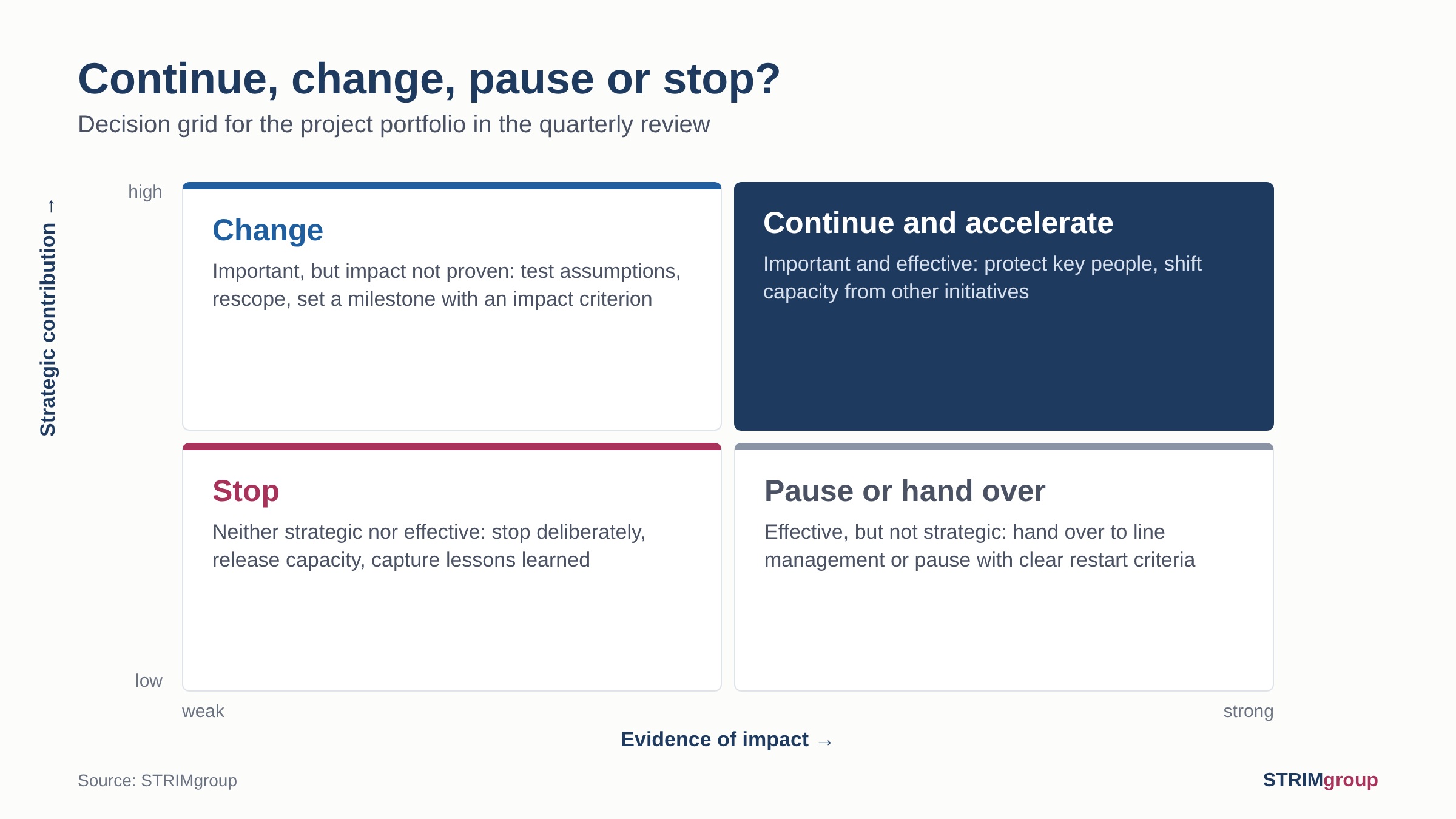
Project prioritisation in practice: stop, pause, get the sequence right
Three examples show what consistent prioritisation looks like: from the energy sector, mid-sized vehicle manufacturing and financial services.
Energy utility: allocating capital selectively, not across the board
Situation: With “Growing Green”, RWE is pursuing a multi-billion-euro expansion of renewable generation. In 2025 conditions deteriorated: high interest rates, supply-chain risks and unclear energy policy, especially in the United States.
Decision: In March 2025, RWE cut its net investment programme to 2030 by EUR 10 billion to EUR 35 billion and raised the required return on new projects from 8 to 8.5 per cent. New US investment decisions were put on hold until permits and remuneration were clear. At the end of 2025, RWE also agreed the sale of an offshore wind project in the Baltic Sea to redeploy capital into higher-return projects.
Outcome: Since summer 2025, RWE has resumed investment decisions in the US as conditions became clearer. The strategy itself remained unchanged. At the annual results press conference in March 2026, CEO Markus Krebber summed up the principle: “We are not spreading this money around indiscriminately.”
The lesson: What was stopped or paused were implementation paths, not the strategy. Project prioritisation requires clear criteria for every pause, defining when an initiative will restart.
Vehicle manufacturer: stabilise before starting something new
Situation: A mid-sized vehicle manufacturer from Baden-Württemberg with around 500 employees and roughly EUR 150 million in revenue was under pressure after an ERP migration. A restructuring had halved the accounts payable team, and master data was flawed.
Focus: From 2025, the project concentrated on three levers over nine months: cleansing master data, selectively automating account assignment and approval, and documenting critical processes.
Outcome: According to the project report, 45 per cent of purchase-order-based invoices are now posted automatically. The month-end close is one working day faster, and the payment run takes only half the time.
The lesson: When capacity is scarce, project prioritisation is above all a decision about sequence. Stabilise the foundation first, then tackle further improvements.
Financial services provider: making the portfolio manageable
Situation: A financial services provider was pursuing numerous strategic initiatives in finance, sustainability, HR and sales. A shared view of priorities, progress and impact was missing.
Approach: STRIMgroup set up a Strategy-to-Execution Office and took on interim responsibility for strategy management. This included a shared initiative portfolio, an implementation roadmap, clear governance and regular reporting to the Executive Board.
Outcome: Around 25 initiatives were steered transparently. Achievement of annual targets rose by 19 per cent.
The lesson: Effective project prioritisation first requires a shared view of all initiatives. Only then does it become visible which initiatives are blocking each other.
Four questions CEOs and CFOs can use for project prioritisation
Studies and practice point to a clear leadership task. Ongoing initiatives need to be reviewed regularly, based on their economic contribution, not just their progress.
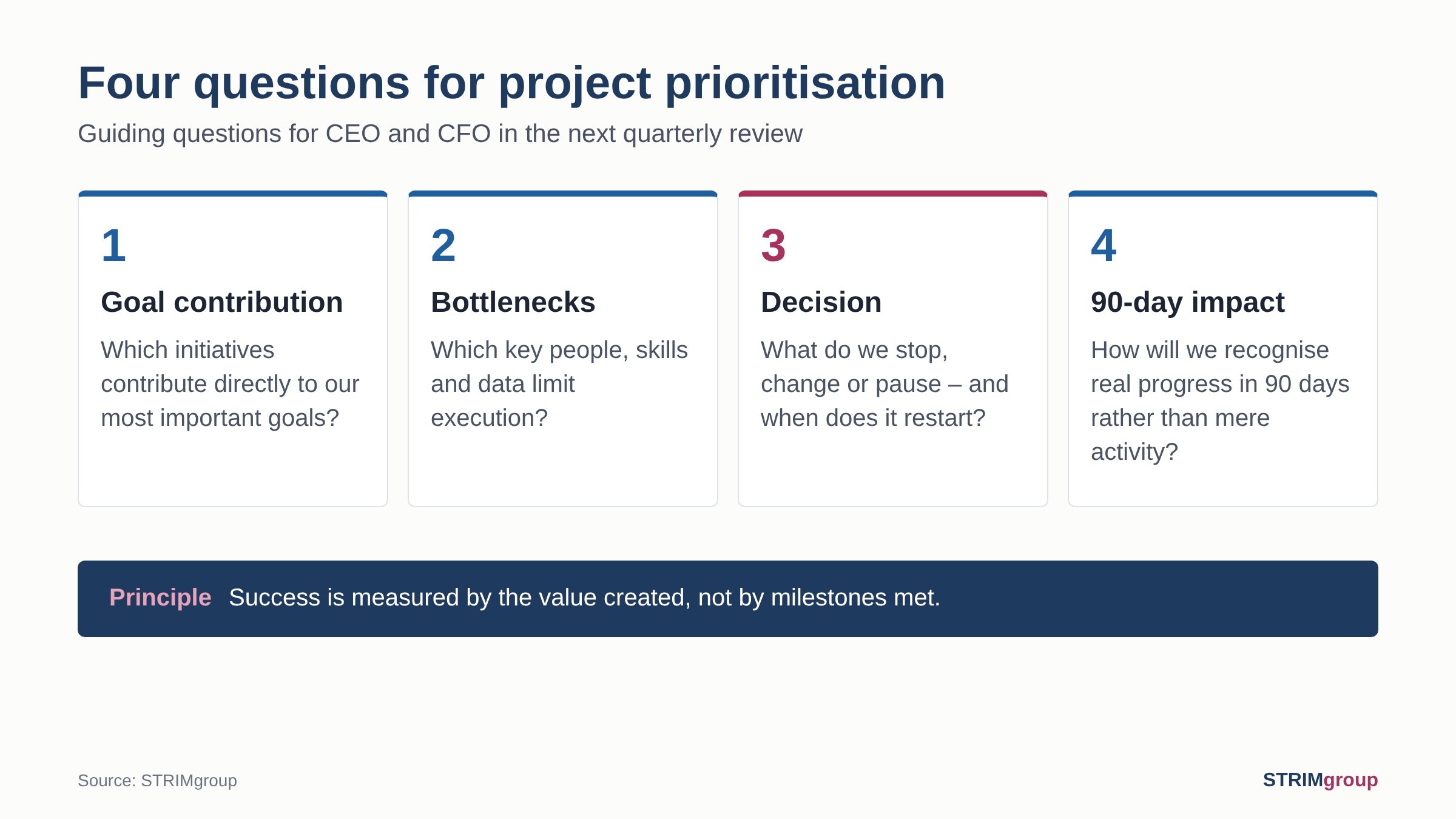
1. Which initiatives contribute directly to our most important goals?
Every initiative must be linked to a clear corporate goal: growth in priority markets, delivery capability, productivity, cost or risk. If that link is missing, the initiative must be justified anew. This makes project prioritisation a question of strategy rather than of who speaks loudest in management meetings.
2. Which bottlenecks limit our execution?
Budgets alone are not enough for this assessment. Management capacity, critical skills, data quality and the organisation’s capacity to absorb change matter just as much. Several sensible projects block each other if they need the same key people. Good project prioritisation therefore records which key people each initiative ties up. Why exactly these skills will become even scarcer in the next upturn is explained in the first part of this series on the skills shortage in SMEs.
3. What do we stop, change or pause?
This question does not belong at the end of a failed project, but in every quarterly review. In project prioritisation, this means every initiative has a documented decision. Money already spent is no argument for continuing. Whoever pauses an initiative also defines the conditions under which it will restart. Internally, stopping a project is often seen as a defeat. In reality, it is frequently the smartest economic decision.
4. How will we recognise real progress in 90 days?
No transformation is complete in 90 days. But the first verifiable results should be visible: better process metrics, investment decisions takes, bottlenecks removed or assumptions confirmed. Project prioritisation that aims to prove impact clearly separates results achieved from effects still expected.
Systematic project prioritisation: the STRIM perspective
In our view, many transformation programmes fail not for lack of plans, but for lack of consistency in setting priorities. Anyone who wants to prioritise projects and reallocate resources first needs transparency on goals, ongoing initiatives, critical bottlenecks and expected results.
This is where the Transformation Readiness Scan comes in. In two to three weeks, we work with the leadership team to clarify what will be stopped, what will be prioritised and how execution will be steered. The result is not another list of measures, but a well-founded selection of a few priorities and a decision paper for management.
What happens next is decisive. A one-off prioritisation fizzles out if everything runs in parallel again in day-to-day business. The Strategy-to-Execution Office therefore establishes a binding management rhythm of portfolio board, impact reviews and clear decisions. It is deliberately not a project office and not a reporting office. At fixed intervals, it asks the core question of this article: continue, change, pause or stop? How such steering differs depending on the starting point is described in our article on steering strategy execution.
Conclusion: project prioritisation means consciously letting go
- More initiatives do not mean more transformation. Too many good projects weaken the ability to execute.
- Project prioritisation requires the willingness to stop ongoing initiatives or to pause them with clear criteria.
- Success is measured by the value created, not by milestones met.
Building capacity takes time. Freeing up capacity is a decision you can take in your next quarterly review.
Now over to you: which three initiatives would you stop if you had to decide again today? Feel free to share your view in the comments.
STRIMgroup/?page_id=2598p helps organizations move from uncertainty to focused execution.
Your strategy has been decided, but the impact is not materialising? With the Transformation Readiness Scan, we clarify within two to three weeks which of your initiatives create value and which tie up capacity. The Strategy-to-Execution Office then ensures that these decisions hold in day-to-day business. Start with an initial non-binding discussion with me on prioritising your current initiatives.

Leave A Comment