
From AI “Adoption” to AI “Advantage”: What the Best HR and People Analytics Articles of 2025 Mean for the Workforce Agenda.
In 2025, the debate clearly shifted. David Green illustrates this in his annual selection of the most important HR and People Analytics articles. The focus is less on whether companies use AI. What matters is how AI translates into a sustainable advantage.
Green structures his collection into 11 thematic areas, including AI & Future of Work, People Analytics, Strategic Workforce Planning, Skills-Based Organisations, and the HR Operating Model. This makes it clear which building blocks must work together. Only then does the “Future of Work” become a management reality—rather than remaining a concept.
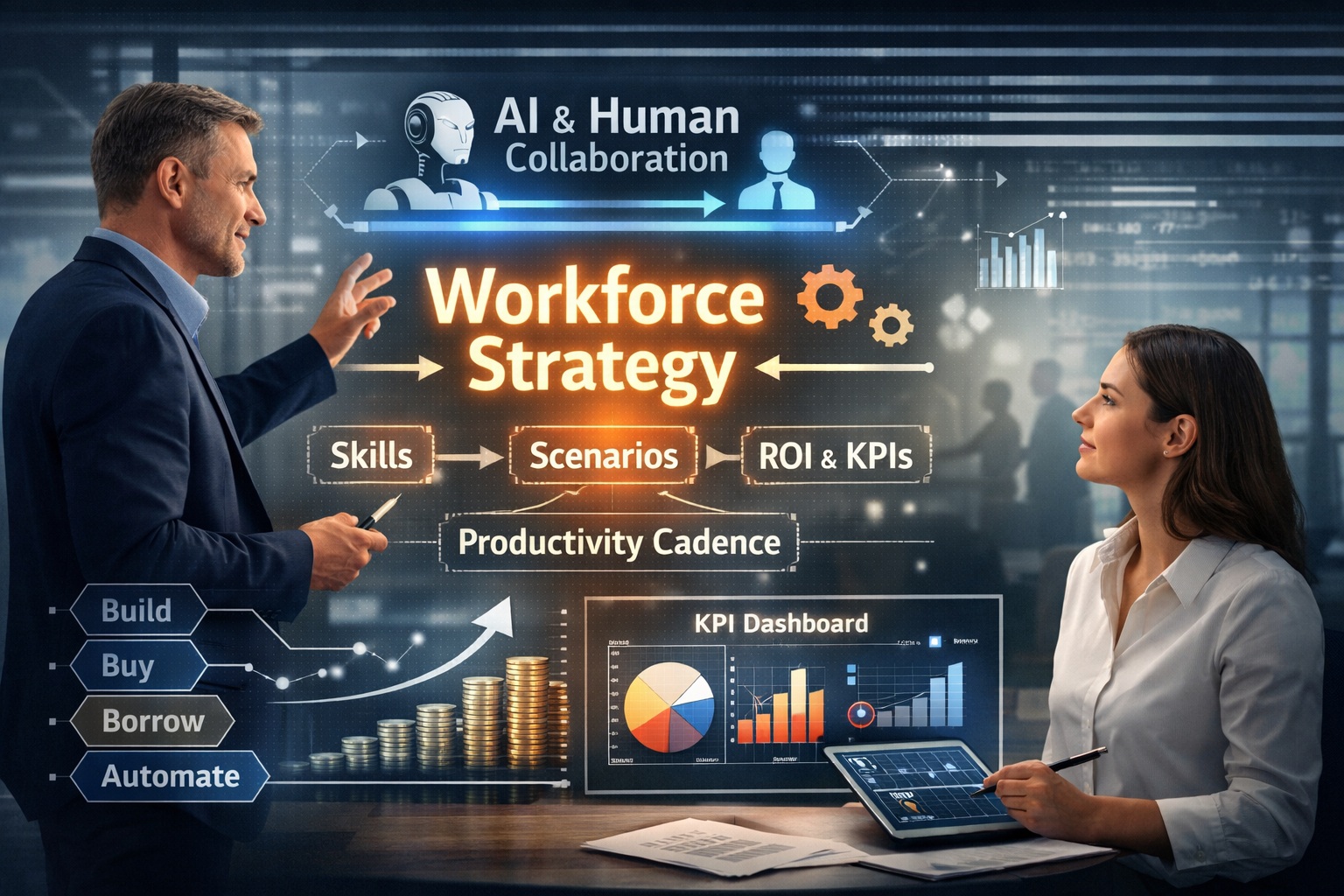
In parallel, STRIM Future Workforce™ addresses exactly this translation challenge: strategy is turned into an actionable workforce logic—roles, skills, capacity, costs, scenarios, and an initiative portfolio along Build/Buy/Borrow/Automate, including a business case and a governance cadence.
The key question for an external C-level discussion is therefore: Where do Green’s “Best of 2025” insights overlap with STRIM Future Workforce™? And what does that mean in concrete terms for the CEO, CHRO, and CFO?
CEO perspective: Workforce as a Value Driver, Not an HR Topic
Green’s signal: Many contributions make one point clear: competitive advantage does not primarily come from tool rollouts. It comes from work redesign. The critical factor is balancing efficiency, trust, and human judgment. Particularly influential is Stanford’s work on AI agents and the “Human Agency Scale.” It clarifies when humans should remain “in the loop.” This becomes a management tool for leading work in agent-based environments.
STRIM Future Workforce™ translation: For CEOs, the value lies in safeguarding growth despite constraints. This is enabled through a workforce target state and robust scenarios (growth, efficiency, turnaround). It is complemented by prioritized initiatives with clear owners and KPIs.
C-level takeaway: When AI changes work, workforce governance becomes strategic work. The lever is clear models for critical roles and capacity. Risks must be made visible. Measures must be prioritized so they can be managed within a few weeks. Otherwise, they get lost in programs.
CHRO perspective: From “HR as Support” to “HR as a Business Partner”
Greens Signal: People analytics is seen as a core capability of modern HR. At the same time, expectations around maturity are rising. Impact does not come from more reports. It comes from clear business questions, good data, high adoption, and above all accountability. Green points to contributions that systematically clarify ownership—covering data governance, stakeholder management, platforms, and functional AI. This turns People Analytics into a true “impact architecture.”
In addition, the ROI perspective emphasizes: analytics links HR initiatives to the metrics that matter at the C-level, strengthening the ability to credibly demonstrate outcomes.
STRIM Future Workforce™ translation: STRIM addresses typical CHRO pain points directly. Workforce risks are made transparent—such as bottleneck roles, skill gaps, time-to-fill, and attrition. A pragmatic role and skills taxonomy creates order. Baseline data on FTEs, skills, and costs is consolidated. This makes HR “connectable” to business strategy.
C-level takeaway: HR does not become more strategic simply because AI exists. HR becomes more strategic when it becomes decision- and steering-capable. The practical path: a clear scope across workforce segments (critical roles/skills), a robust set of scenarios, and an operating rhythm that forces decisions. Reports are a means to an end—not the end itself.
CFO perspective: ROI, Transparency, and a Finance-Ready Steering Logic
Greens Signal: A recurring motif is that People Analytics can measure ROI. This works when proven business methods are applied—such as scenario analysis, total cost of ownership, and portfolio thinking. This matters because human-capital investments grow faster in the AI era. They also become riskier. As a result, a valuation logic that finance accepts is required.
At the same time, SWP contributions stress that strategic workforce planning must become “business as usual.” It needs scenarios, and it must look at capacity and capabilities—not just headcount.
STRIM Future Workforce™ translation: For CFOs, investment confidence is central—alongside personnel cost management and scenario comparison. Core artifacts include a CFO readout/business case, a prioritized initiative portfolio, and a KPI set that ties together productivity, staffing, skills, and cost. Examples include “Workforce Cost per Output,” “Productivity per FTE,” and “Automation Yield.”
C-level takeaway: Workforce becomes manageable as an investable portfolio when three things hold. First, assumptions are transparent (scenarios). Second, impact is measurable (KPI set). Third, decisions are made regularly (governance cadence). Scorecards and reviews are therefore more than reporting. They are the control system for workforce value.
Common Denominator: A Governance Cadence Instead of a One-Off-Project
A robust intersection between Green’s map and STRIM Future Workforce™ is moving away from one-off projects. The center of gravity is a repeatable steering mode.
Green/SWP emphasizes that workforce planning must become “business as usual.” It cannot remain reactive.
STRIM operationalizes this as a Monthly Workforce Review. This includes a clear agenda and a workforce KPI scorecard. Owners are explicitly assigned. Actions for “red” are predefined.
This shifts the discussion. It is less about “Which initiative is right?” It is about “Which system ensures we consistently make and execute the right decisions?”
Closing Thought
David Green’s “Best of 2025” paints a clear overall picture. AI, skills, People Analytics, and SWP are no longer separate disciplines. They become building blocks of an integrated steering system. This system addresses productivity, risk, and growth at the same time.
STRIM Future Workforce™ is strong where many organizations fail: translating strategy into an actionable workforce logic. This includes scenarios, an initiative portfolio, a business case, and a robust governance cadence.
If 2025 was the year of major strategic inflection points, then a simple C-level question follows for 2026: Do we have a workforce system that doesn’t just analyze AI-driven change—but translates it into decisions, priorities, and measurable impact?
