
The skills shortage in SMEs is entering what may be its most dangerous phase for business growth. That sounds paradoxical.
After all, only 21% of German companies currently report that a lack of skilled workers is holding back their business. In 2022, that figure was more than twice as high (KfW Research, June 2026).
But the underlying skills shortage has not disappeared. It is merely being masked by weak economic conditions. The real question is therefore: What will your company do with this breathing space before orders pick up again?
Why the Skills Shortage in SMEs Needs Reassessment Now
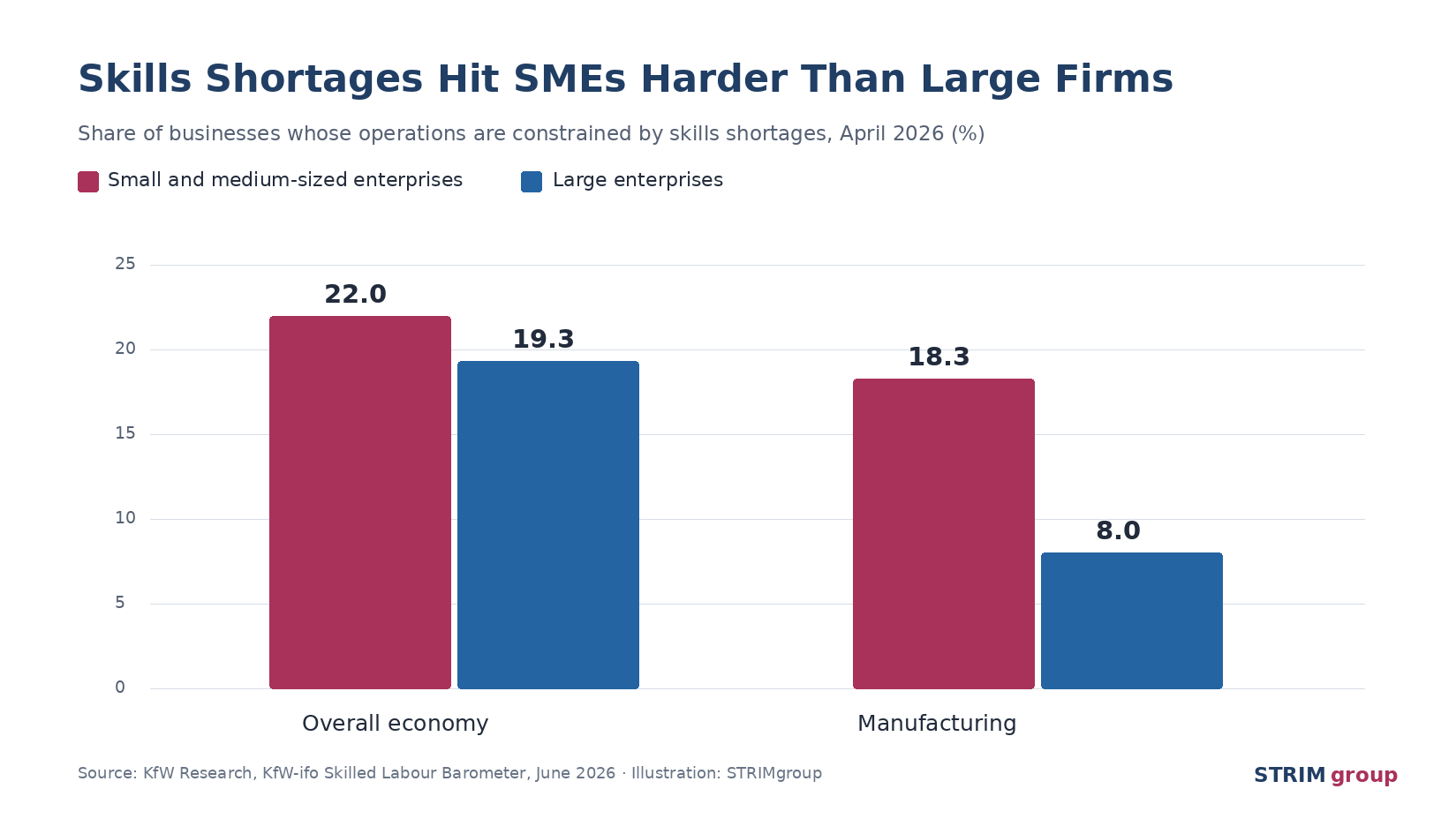
The latest figures reveal one important trend: Small and medium-sized enterprises (SMEs) are more severely affected by skills shortages than large corporations.
In April 2026, 22% of German SMEs reported difficulties finding skilled workers, compared with 19.3% of large companies. The gap is even wider in manufacturing: 18.3% of SMEs reported shortages, versus just 8% of large enterprises.
Dirk Schumacher, Chief Economist at KfW, attributes the current easing primarily to Germany’s weak economic performance. He expects skills shortages to intensify again once the economy recovers.
The German Economic Institute (IW) paints a similar picture. According to its labor market projection through 2029 (available in German only), Germany’s skilled labor gap could increase to approximately 723,000 workers, representing a rise of 47%.
Importantly, this is a continuation of existing trends rather than a forecast.
One particularly striking finding is that industrial occupations such as mechatronics and mechanical engineering are moving higher in the shortage rankings, even as industrial employment declines.
A further dimension is emerging: the relationship between skills shortages and investment.
An IW study commissioned by the BlackRock Foundation estimates an average shortage of more than 148,000 skilled workers for infrastructure, the energy transition and digitalization alone (Börsen-Zeitung, October 19, 2026, available in German only).
The underlying message is clear: Capital investment alone does not create execution capacity.
This applies equally to Germany’s federal infrastructure investment initiatives and to the growth ambitions of family-owned businesses.
Another structural shift is underway. According to figures cited by the ifo Institute, German industry has lost almost half a million jobs subject to social insurance contributions since 2019. Over the same period, the service sector has created more than 2.2 million jobs.
Experienced industrial specialists leaving the workforce today will not automatically be available when the next economic upturn arrives.
The Blind Spot: Orders Return Faster Than People
For years, the discussion surrounding skilled labor shortages has largely focused on recruitment.
Who can attract qualified candidates faster? Which company has the more effective employer brand? How can hiring processes be accelerated?
These questions matter, but they overlook the fundamental problem.
The real challenge is a mismatch between business and workforce development timelines.
New orders, investments and market opportunities can materialize within weeks. Developing critical capabilities, however, often takes months or even years.
Despite this reality, many executive teams continue to plan in the opposite direction.
According to PwC´s 29th Global CEO Survey, German CEOs spend 49% of their time on issues with a planning horizon of less than twelve months. Only 15% of their time is devoted to decisions extending beyond five years.
At the same time, 57% question whether their organizations are transforming quickly enough.
A special survey conducted as part of the KfW SME Panel illustrates the potential consequences.
According to the findings, 58% of SMEs anticipate difficulties filling vacancies over the next five years. Among those businesses, around 40% consider it likely that they will have to decline orders because of staffing constraints (VerkehrsRundschau, March 2025, available in German only).
In other words, future growth may be constrained not by market demand, but by the organization’s own ability to deliver.
Why does this challenge affect smaller companies particularly severely?
Large corporations can often compensate for skills shortages across locations, business units and budgets. SMEs rarely have the same flexibility.
In a medium-sized manufacturing company, entire product lines may depend on just a handful of highly specialized employees.
The skills shortage in SMEs is therefore not simply an HR issue. It is a strategic question of delivery capability, competitiveness and sustainable growth.
Skills Shortage in SMEs: Five Steps Successful Companies Take Now
There is also good news.
The temporary easing of labor market pressures creates valuable time for companies willing to act before demand accelerates again.
Those that use this period strategically can enter the next economic upturn with a significant competitive advantage.
From my perspective, five steps make the difference.
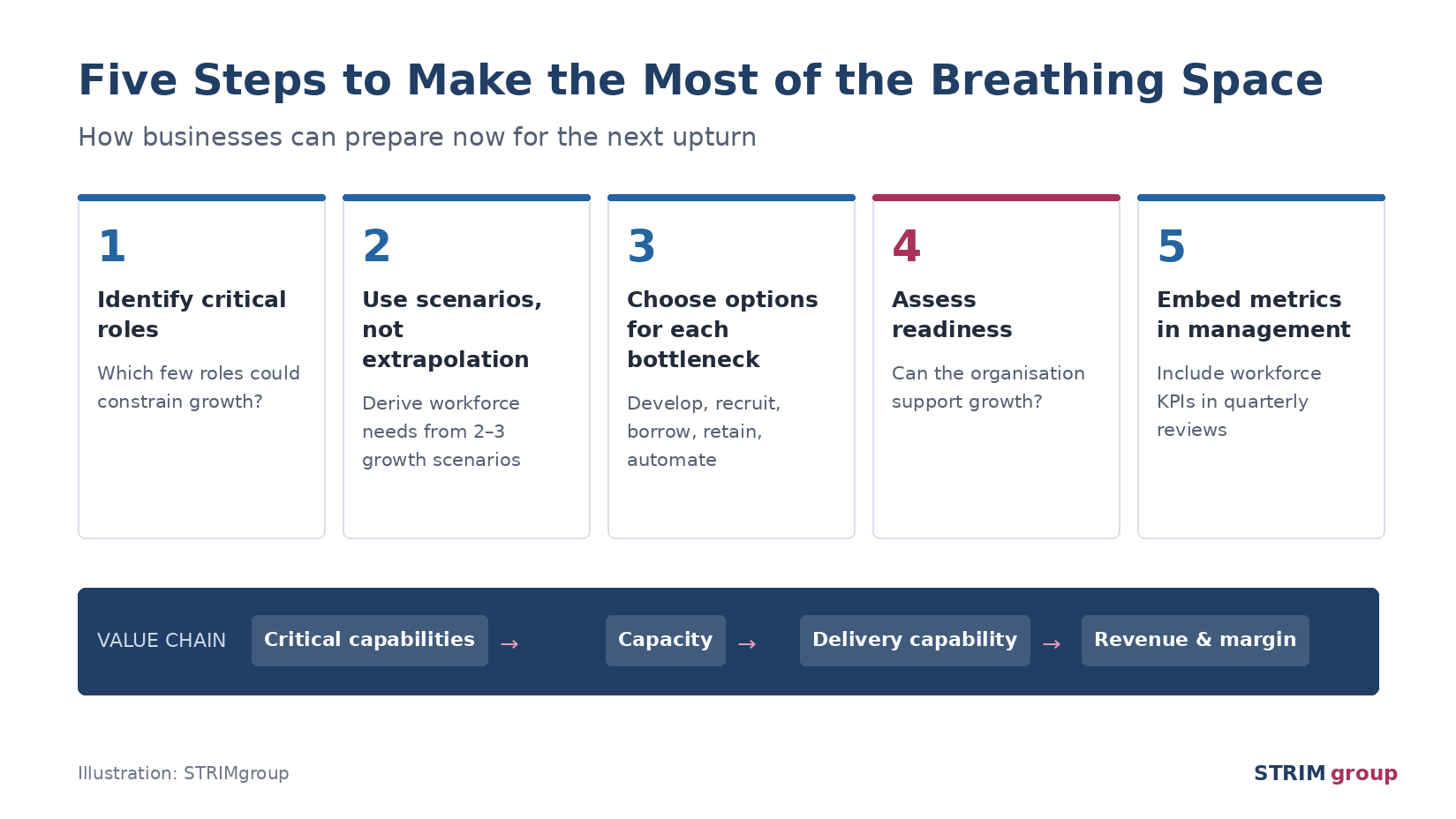
1. Focus on Bottlenecks, Not Headcount: Identify Critical Roles
Traditional workforce planning counts positions and employees.
Strategic workforce planning asks a different question: Which specific roles and capabilities actually determine whether the company can grow?
These are often specialists in engineering, commissioning, data management, automation or technical sales.
When capacity is missing in these roles, entire value chains can be disrupted.
Addressing the skills shortage in SMEs therefore starts with identifying the few critical positions that directly influence operational capacity and future growth.
The objective is not to create a comprehensive list of vacancies, but to identify the positions where a shortage could have the greatest business impact.
2. Use Scenarios Instead of Extrapolation: Derive Workforce Demand from Strategy
What would happen if incoming orders increased by 20%?
How many additional employees would be required? More importantly, which skills and competencies would become critical?
In “The State of Organizations 2026”, McKinsey recommends regularly assessing operating models and talent pipelines against alternative future scenarios.
For SMEs, this means developing two or three realistic growth scenarios rather than simply extrapolating last year’s staffing levels.
Each scenario should identify:
- Which roles will become critical first.
- Which competencies will be required.
- When shortages are likely to emerge.
- How long it will take to close the gaps.
This approach transforms workforce planning from a reactive administrative exercise into a forward-looking management instrument.
3. Develop Options for Each Bottleneck: Build, Buy, Borrow, Retain or Automate
Every critical workforce gap can potentially be addressed through several approaches.
Companies can develop capabilities internally, recruit externally, collaborate with partners, retain key employees or automate selected activities.
Each option involves different costs, risks and implementation timelines.
Internal development may take years. External recruitment can require several months. Partnerships may provide faster access to expertise, while automation can reduce dependence on specific roles.
Managing the skills shortage in SMEs therefore requires a deliberate combination of measures rather than relying on recruitment alone.
The critical decision is not merely which option to choose, but when to initiate it.
That decision needs to be made today, not when the next wave of orders is already arriving.
4. Assess Readiness: Can the Organization Support Growth?
Before committing to major investments, management should take a critical look at organizational readiness.
Are leadership structures, processes and competencies prepared for the next phase of growth?
Can the organization scale operations without creating new bottlenecks?
Are critical dependencies on individual employees sufficiently understood?
Or could the company’s growth strategy fail because of workforce constraints that are already visible today?
A structured readiness assessment can reveal these risks before they turn into operational problems.
An external perspective is particularly valuable. Internal teams may become accustomed to existing limitations and recognize critical shortages only when they begin affecting delivery performance.
Identifying organizational constraints early is far less costly than recovering from a missed growth opportunity.
5. Integrate Workforce Metrics into Management Reviews
Critical workforce capabilities should be reviewed with the same discipline as revenue, profitability and cash flow.
The underlying value chain is straightforward:
Critical skills → Operational capacity → Delivery capability → Revenue and profitability
This relationship needs to become transparent.
Relevant management indicators include the availability of critical competencies, time to fill strategic positions, time to full productivity and dependence on individual experts.
By integrating these indicators into quarterly business reviews, organizations can monitor whether their workforce capabilities remain aligned with strategic objectives.
Only then does workforce planning become a measurable management responsibility rather than an isolated HR activity.
Skills Shortage in SMEs: Two Practical Examples, One Principle
What does this approach look like in practice?
Two examples illustrate how organizational size influences the methods used, while the underlying strategic logic remains the same.
Case 1: A Manufacturing SME with 45 Employees
Initial Situation: The Brandenburg-based mechanical engineering company bip technology exports its products worldwide.
However, the company struggled to find qualified candidates in its region who were willing to undertake international assignments (ZDFheute, March 2026, available in German only).
Challenge: The company needed to fill critical skilled positions for which the regional labor market could no longer provide sufficient candidates.
Approach: The company expanded its recruitment efforts internationally, including to Morocco and Iran.
It received support through a program involving the German Chambers of Industry and Commerce (DIHK) and the Federal Employment Agency.
Outcome: Today, one-quarter of the company’s workforce has a migration background.
However, the first recruited mechatronics technician required eight months before entering Germany.
The lesson is clear: Organizations that begin addressing critical workforce shortages only when order books are full may already be too late.
Case 2: A Large International Electrical Engineering and Automation Company
Initial Situation: An internationally operating company with several tens of thousands of employees faced substantial projected net workforce demand while also experiencing the departure of experienced managers.
Existing workforce planning was largely quantitative. Critical roles and competency dependencies remained insufficiently visible.
Challenge: The company’s business strategy needed to be translated into reliable workforce requirements.
Approach: Working with HR and business units, STRIMgroup identified critical capability profiles, including specialists in data and IT as well as international engineering.
Future demand and existing workforce capacity were compared across job families, regions and organizational units.
Based on workforce segmentation, appropriate measures were selected for each identified capability gap.
Outcome: A value-driver tree now links workforce measures to management indicators.
The analysis also revealed an important methodological insight: Nominal revenue was becoming less reliable as a driver of workforce demand, while volume-based operational indicators provided a more robust basis.
Further details on this approach are discussed in our article on strategic workforce planning with people and AI.
The Common Principle
Although the two organizations differ significantly in size and complexity, the underlying approach follows the same principles:
- Identify critical workforce bottlenecks before they affect revenue.
- Account for realistic lead times when developing capabilities.
- Select appropriate measures for each bottleneck instead of automatically initiating recruitment.
In a small manufacturing company, a single critical appointment may determine operational performance for months.
In a large corporation, systematic workforce planning can shape organizational capabilities for years.
In both cases, workforce shortages become more manageable once they are treated as strategic business risks rather than isolated staffing problems.
What the Skills Shortage in SMEs Means for CEOs, CFOs, and CHROs
Workforce risks can no longer remain exclusively within the HR function.
They must become part of strategic business management.
For CEOs: Make Workforce Risks Part of the Growth Strategy
The CEO determines whether critical workforce risks are explicitly incorporated into business strategy and strategic investment decisions.
Without this commitment, workforce planning often remains an HR exercise with limited influence on corporate priorities.
The central question is whether the organization possesses the capabilities required to execute its growth strategy.
For CFOs: Treat Workforce Bottlenecks as Investment Risks
CFOs should assess critical workforce constraints using the same economic discipline applied to capital investments.
An unfilled specialist position can potentially result in greater lost revenue than a delayed machinery investment.
Workforce-related risks therefore belong in financial planning, investment evaluations and performance management.
For CHROs: Translate Business Scenarios into Workforce Requirements
CHROs need to derive workforce demand from strategic scenarios rather than existing staffing plans.
This also requires management indicators that are meaningful beyond the HR function.
Examples include:
- Time to fill critical positions.
- Time to full productivity.
- Availability of strategic competencies.
- Dependence on individual specialists.
- Exposure to future workforce gaps.
For further insights into the connection between workforce capabilities and strategy, see our article on workforce risks as a strategic bottleneck.
Securing critical capabilities, however, is only one part of the solution.
Organizations can also release capacity by discontinuing initiatives that consume scarce resources without generating sufficient strategic value.
This requires management teams to examine not only what their organizations should start doing, but also what they should deliberately stop doing.
Conclusion: Tackling the Skills Shortage in SMEs Starts Now
The current breathing space should not be mistaken for a structural solution.
Three conclusions are particularly important:
- The skills shortage in SMEs has eased cyclically, but the underlying structural challenges remain unresolved.
- Future growth may be constrained less by market demand than by the organization’s ability to execute.
- Companies that identify critical roles, develop strategic scenarios and initiate appropriate measures today will be better positioned for the next economic upturn.
The real opportunity lies in acting while the pressure is temporarily lower.
Now I would like to hear your perspective:
Which role in your organization would become the first bottleneck if incoming orders increased by 20% — and how long would it take to fill that position?
I welcome your thoughts in the comments.
STRIMgroup helps organizations move from uncertainty to focused execution.
Would you like to understand where your organization could reach its limits during the next growth phase?
With our STRIM Future Workforce™ approach, we translate your growth scenarios into critical roles, competency gaps and actionable options for addressing workforce bottlenecks.
As an initial step, our STRIM Transformation Readiness Scan™ provides clarity on the most significant execution risks and opportunities for improvement.
Alternatively, you can begin with a non-binding introductory discussion with me to assess your organization´s critical workforce risks.

Leave A Comment